Twentieth Sunday after Pentecost
The invitation to live
Philippians 4:1–9; Matthew 22:1–14
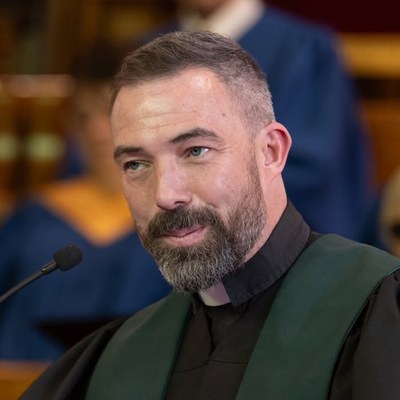
“Come to my party — but if you don’t, I’ll burn your town down.”
That’s the invitation the king makes in this parable told by Jesus. He throws this big party for his son’s wedding, saying:
Tell those who have been invited: Look, I have prepared my dinner, my oxen and my fat calves have been slaughtered, and everything is ready; come to the wedding banquet.
Matthew 22:4
When the invited guests turn down the invitation, the king is enraged and sends his troops to burn their city. So much for invitations. It’s such a weird story.
Today I want to talk about why that parable is so odd — or at least my theories as to why — and what Jesus is really saying about this gift of life.
First, we need to remember that this is a parable, meaning that it is a story Jesus tells as an allegory, full of metaphor and layers of meaning. In today’s parable, the first layer might be a historical one. It would likely have been read first as a story that told of the Jewish rejection of Jesus as their Messiah. Jesus is the Son of God, the king; God the Father is throwing a banquet. The Jewish people are the first ones invited, but when that invitation is treated lightly and ignored, others are then invited. Worse, some mistreat the messengers — and here Jesus is seen both as the Son and the messenger. In response to their treatment, the king burns the city and then invites everyone else to come to the party, meaning God invites us, the Gentiles, in.
As early believers shared stories about Jesus, this interpretation of the parable would have answered a couple of questions lingering on their minds. One of them being: why did God allow the destruction of Jerusalem in the year 70? The destruction of the Second Temple was a pivotal moment. It was kind of, for them, like watching the Notre-Dame Cathedral in Paris burn, except a hundred times worse. Everyone was asking themselves how God could allow that to happen. Some readers turned to this parable to say that it was punishment for having killed God’s messenger.
Now, I have issues with that interpretation. I think it’s dead wrong. God is not that petty, and God has no need for that type of vengeance. Also, the inclusion of us Gentiles in the party was not an afterthought, as if we’ve been invited only because others turned God down. No — our inclusion, the inclusion of the whole world, was part of the plan from the beginning.
So I disagree with that old interpretation, as I’m allowed to do. That is the beauty of a parable: the meaning that brings one generation comfort may not work for the next generation, and we can interpret these things differently.
Another way this parable is interpreted is spiritually. The king represents God, who is inviting us into heaven. Some people reject that invitation, but then God goes out and invites more — invites everyone. All are welcome to the banquet.
Now, that interpretation works as long as we ignore the violent bits. The gospel writer Luke did indeed ignore the violent bits when he told the same story. He omits any reference to the messengers being killed or the city being burned. I really like Luke’s version of this story. I think that’s what you should read at my funeral. (I keep planning for this funeral; I’ve got it all worked out.)
But looking at Matthew’s account, we need to make sense of this violence, because we can’t ignore it today. And that makes me think there must be more going on in this story.
For me, I think the story is indeed an invitation to heaven — where heaven is not just the afterlife. Heaven, and this heavenly banquet, is something that came with Jesus, something we are being invited to by Jesus, and something I can experience now, today, through Jesus. Today I am presented with this gift of life in Christ. Today I can taste heaven; I don’t need to wait until I die. If I have the eyes to see it and the heart to accept it, I can get these glimpses of heaven all around. I can celebrate at the banquet table now, knowing that I am shoulder to shoulder with the saints all around me.
Jesus promises life in all its fullness, and that life is given to us while we are alive. It is now that we are blessed, now that our cup is overflowing. It’s going to overflow even more in the new heaven and earth to come, but it is overflowing now, too. You can experience that fullness of life right now. I think that’s the invitation being given to us.
God is presenting us with a feast of life, this blessing that is planet Earth. But how do we respond to it?
We shrug.
The leaves are changing colour into fiery reds and golds and vibrant yellow — and we shrug. Our tables abound with pumpkin and squash and apples and potatoes. Our bodies are breathing, moving, standing, digesting, blood pumping through our veins, and we don’t think anything of it. We’re being offered this unimaginably astounding gift of life, and we tend to treat it lightly. God sends out these invitations, and we just leave them on read.
Worse, we are offered life in its fullness, and we decide to go back to work instead. Sure, there’s a wonderful life outside our windows, but we’ll get to that when we have time. Creation screams, “Come out and play!” and we say, “Oh, wait until I retire. We need to save up first before we start enjoying it.”
Now, work is important. You’re gonna need that income. But work can so easily get in the way of our calling — a calling to delight in the Lord our God, to relish this blessing of life that God gives us. What’s the chief end of man? To glorify God and enjoy him forever. Your first call is to enjoy. Glorify God by enjoying God, enjoying your life, enjoying yourself.
Christ offers us life in its fullness. He tells us not to worry, for God will provide; tells us to ask and we shall receive; to trust that God will provide. Instead, we let anxiety and stress rob us of that joy. We turn down the invitation, too busy with our fields and our businesses.
Now, I know there are a number of us here without work, so you might hear me and think, “Oh, goodness, I wish I had the problem of working too much.” Maybe you’ve already tuned out, thinking Mark isn’t talking about you. So let me be a little more inclusive. This message is for you, too.
When we are without work, work becomes even more consuming. We lose our sense of identity and purpose when we lose our jobs. It gets harder to enjoy this gift of life — not because we lack resources (enjoying life has nothing to do with money), but because it feels wrong to enjoy life. We feel guilty for taking that time to rest. We feel the pressure that we should be doing more. Society places so much shame on those who are unemployed. But instead of using the free time we now have to make art, to play music, to visit friends, to just be happy, we trap ourselves indoors, burdened with guilt and self-loathing.
Yeah, you need money. Your job now is to find a job. But in the meanwhile, you are also invited to feast at God’s banquet. God has been providing for you; God will continue providing for you. And on the Sabbath, you get full permission to rest and delight in the beauty that surrounds you — to enjoy this gift now.
When invited to the banquet, some made light of it. Some shrugged and went back to their fields or businesses. But in Matthew’s gospel, some seized the messengers, mistreated them and killed them.
When presented with the bounty of life, with the opportunity to be wildly creative and unique, to deck ourselves in colour like the leaves of the forest, to party with creation, we sometimes reject it. We turn to anger, sullenness, violence. We have choices, you know, and so many of us choose to kick this gift of life in the teeth. We cringe at people who seem too joyful. We roll our eyes at people who are too exuberant. We sneer at those who don’t conform to society’s monotony. And as a result of rejecting this gift of life so violently, we live as burned-out, hollow shells of our humanity.
The destruction isn’t punishment. It’s consequence. When we choose not just to reject the gift but to trample on those who try to share their joy with us, then we end up living in desolation. We choose misery and anger, so misery, anger and despair is all we see around us.
But the invitation to live in all its fullness continues. If some don’t accept it, fine — there are others who will. The party is going to go on regardless, and no one is going to stop it.
Now, in Matthew’s parable there’s this little epilogue. A man joins the party, but he’s not wearing the wedding robe, so the servants tie him up and throw him out. I think that means that as we get invited to this party of life, we’ve got to show up dressed for it. You can’t just waltz in like the party doesn’t matter. You’ve got to come ready to dance and feast and have fun. There are no spectators here; we are being called to participate.
How do we dress for it? What are those metaphorical wedding robes? I think one of them is the garment of thankfulness. It is recognizing, in humility, that we are guests at this fantastic feast, invited to dance at God’s party, given an honour that’s not deserved — an honour simply extended because God is generous, because God is full of joy and wants you to feel that joy, too. It’s a joy that stays with us when life is dark, a joy that’s present even when we’re sad. It’s a gratitude for every breath, even when it’s hard to breathe; a delight that persists in times of struggle. It is a thankfulness known most fully by those who have been invited in off the highways and byways of life.
Friends, we’ve been invited to this feast — to dress ourselves in gratitude, wrapping ourselves in wonder, adorning ourselves with joy — and I pray that we do rejoice in it. And when you go out and encounter someone whose joy has been beaten down by the world, may we be the people who help them find it again. Because the banquet is not just for us. It is for all: for those in the sanctuary, and everyone off the street.
The world will give us a thousand reasons to put off the party. There’s always more work to do, always another worry to entertain, another reason to tell yourself you’ll enjoy life later. But your invitation is for today. Today the table has been set, the feast is prepared, the party has already started. May we accept this extraordinary invitation to live, and celebrate it with every fibre of our being. Amen.
The readings
This Sunday
Hear it in the room
Worship at 11:00 a.m., doors open at 10:30. Everyone is welcome.
Plan your visit