Sixteenth Sunday after Pentecost
Women of the Bible
Exodus 15:20–21; Joshua 2:1–7; Esther 4:12–17; Luke 10:38–42; John 20:15–18; Acts 9:36–40
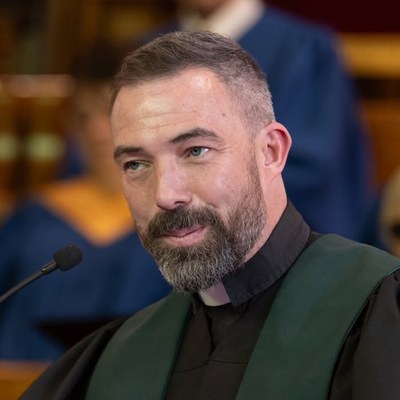
On Christian Education Sunday, the children of First Presbyterian led us through the stories of six women of the Bible. Each story became a stage in the life of faith, from birth to the life beyond. Each reflection below is followed by the reading it opened.
Miriam
While the seed of the nation of Israel is planted in the story of Abraham and Sarah, the real start, the birth of this nation, is in the labour of Israelites escaping Egypt. They are born through the waters of Egypt, first symbolically when baby Moses is retrieved from the reeds, and then physically as they pass through the Red Sea. Egypt was a surrogate, and in this birthing process, Miriam was their midwife. And in both cases, Miriam was there.
I need to emphasize the importance of her presence. We believe the Bible is the inspired Word of God, but it is also written by human hands, in a human context. Most of the time, it was men’s hands, in a man’s world. So every time a woman is mentioned, she is mentioned despite the generations of patriarchal pressure that would’ve excluded her. Like a crocus poking through the snow, her name emerges as a sign of something bigger underneath.
This story of Exodus could have been written simply as the story of Moses and his brother Aaron — that’s the story society would have written if it was writing the story; it is still the story that our pop culture writes today when you consider the backlash that happens when the Ghostbusters were re-written as women, for example.
However, this is not the story God writes. The story that God tells about the birth of Israel is the story of Shiphrah and Puah, the most honourable liars in the world, the story of a Hebrew mother and a Pharaoh’s daughter who scheme together to orchestrate salvation, the story of a sister who walks each step along the Nile with her brother.
Miriam was there, the backbone to Moses’ calls for justice. Miriam was there, sheltering family as the Spirit of Death passed over. And Miriam was there, shepherding the people as they walked on dry land across a Red Sea.
And on the other side of that Sea, when they are finally safe from their oppressors, Moses sings a song about God’s salvation. But so does Miriam. And while it might be short, it is a song that had to break through the noise of grumbling men across the generations, so we could hear it clearly now, and give thanks to God for a brave prophet like Miriam.
Then the prophet Miriam, Aaron’s sister, took a tambourine in her hand, and all the women went out after her with tambourines and with dancing. And Miriam sang to them: “Sing to the Lord, for he has triumphed gloriously; horse and rider he has thrown into the sea.”
Exodus 15:20–21
Rahab
If the Exodus story was the birth of a nation, by the time Israel has wandered through the wilderness and come to the Promised Land, they are metaphoric teenagers.
What is the life task of a teenager? One part is to define who they are, and they do that mostly through opposition to who they aren’t. And all parents in the world groan in unison — you know how frustrating that is. A teenager makes so much noise just to tear everything down, and topple all the boundaries you set to keep them safe. Like the Israelites stomping into Canaan and saying this is ours now and then throwing a tantrum around Jericho until that city finally crumbles.
There is a big hormonal upheaval going through teenagers, but that upheaval doesn’t stay contained within them. It spills out to every aspect of their lives and can topple the system you set up as a family. And I wish I had good advice to help you get through it but I have a thirteen year old in my own life, and I feel just as clueless.
But my hope and trust is that through all the noise and wall-smashing, there will be people like Rahab in my teenager’s life. Rahab was not an Israelite, she was not one of them, she’s not someone you would expect to help them. But by the grace of God, she was there just when Joshua’s spies needed her protection.
We want to protect our teens from all the damage we know they will cause to themselves as they establish their identity. We want to save them from all the mistakes we made, the pain we know. But they can’t become who they are meant to be without going through those battles in life, and sometimes the walls are meant to come crumbling down.
Instead, trust that God is with them in this process, and just when they need it most, God will be there like a Rahab. Not someone you would expect to help, not someone you might know, but the hands of God extending a rope to help save them. We do not do this work of raising children ourselves — trust that the God who has led them thus far is faithful at every step of the journey ahead.
Then Joshua son of Nun sent two men secretly from Shittim as spies, saying, “Go, view the land, especially Jericho.” So they went and entered the house of a prostitute whose name was Rahab and spent the night there. The king of Jericho was told, “Some Israelites have come here tonight to search out the land.” Then the king of Jericho sent orders to Rahab, “Bring out the men who have come to you, who entered your house, for they have come to search out the whole land.” But the woman took the two men and hid them. Then she said, “True, the men came to me, but I did not know where they came from. And when it was time to close the gate at dark, the men went out. Where the men went I do not know. Pursue them quickly, for you can overtake them.” She had, however, brought them up to the roof and hidden them with the stalks of flax that she had laid out on the roof. So the men pursued them on the way to the Jordan as far as the fords. As soon as the pursuers had gone out, the gate was shut.
Joshua 2:1–7
Esther
No longer teenagers, by the time we have the story of Esther, Israel has come into its own as a young adult. Now more mature, more confident, dressing as stylish and alluring as royalty. Esther, the most beautiful woman of Israel, is plucked out of poverty and oppression by the Persian King and made like the Zendaya or Scarlett Johansson of her day. She is now a celebrity, with all the power and trappings of celebrity status.
But a funny thing happens in our young adulthood: after all that work of defining ourselves, after tearing everything down in teenage years and rebuilding who we think we are, we experience moments that really test our values.
You see, as much as we’re convinced that we have nobly crafted our own identities, free and unique from our parents’ provincial backwardness, in the end, we really just replaced their set of values with the opinions and values of our peers, of society in general. We form a pseudo-individuality, thinking we’re now unique, but really just copying our friends. Our peers value beauty and marriage and living in a luxurious palace, so that’s what we think we value too. We pursue the things of this world — it’s hard not to. We want to be loved, we long to find a solid footing, we think we have finally arrived.
But then… There will come a moment when the world’s values collide with what we know to be true; a time when we are asked, what do we really believe in. Esther paces back and forth not just out of fear of the Persian king but because she is debating the core of who she is: Persian princess or child of Israel?
We, too, go through that debate as we establish our lives and values. There come moments when we need to make important decisions that shape who we will become, where we decide where we will root ourselves: in the opinions of our peers and what they think is success? Or in the values we were raised with, the teachings that cross generations, the wisdom that comes from a past we thought we left behind?
It was not an easy choice, but Esther chose bravely.
When they told Mordecai what Esther had said, Mordecai told them to reply to Esther, “Do not think that in the king’s palace you will escape any more than all the other Jews. For if you keep silent at this time, relief and deliverance will rise for the Jews from another place, but you and your father’s family will perish. Who knows? Perhaps you have come to royal dignity for just such a time as this.” Then Esther said in reply to Mordecai, “Go, gather all the Jews to be found in Susa, and hold a fast on my behalf, and neither eat nor drink for three days, night or day. I and my maids will also fast as you do. After that I will go to the king, though it is against the law, and if I perish, I perish.” Mordecai then went away and did everything as Esther had ordered him.
Esther 4:12–17
Mary and Martha
Oh it’s so busy being a full and proper adult. I thought things would slow down by now. I expected a rush of busy-ness in my 20’s and 30’s but as I approach 50, I thought you’re supposed to have everything under control, right? I thought this would be the age for coasting and resting on my laurels. When’s that happen? In your sixties? At retirement? Ever?
As a full and proper adult, there’s just a lot that has to be done. Mortgages have to be paid, reports and tasks need to be completed, kids need to get to school and then hockey practice, don’t forget to volunteer for Sunday School, you need to do coffee with that friend you haven’t seen in months, you know you have to find time to exercise, but now your back has this weird pain you should get checked out, and first you have to cut the grass, and pick up groceries, but you also gotta answer that phone call from your boss, and… and somewhere at some point, the house needs to be cleaned. Who’s going to clean the house and cook dinner? Mary, where are you?
I am very much at a Martha moment in my life. Oh gurl, I get where you’re at. Of course you’re angry with your sister. Mary is just sitting there, hanging out with Jesus, at a time when so much needs to be done. You don’t have time for this. What do you expect to eat if no one is cooking? Why is Martha gotta be the one to pick up that ball?
How good it would be to just sit down for once? To rest. To catch your breath. To breathe. To not have to worry, to let your shoulders down, to trust that it will all be okay, to accept that nothing is perfect, to sit still enough to hear your heart beat, to slow down enough to hear yourself think, to pause in stillness to hear Christ speak.
You know what? Maybe it doesn’t all have to be done. Maybe we can fall behind schedule. Maybe it’s okay that the meal isn’t ready yet. Maybe a few tasks can slide. It is important to sit still. With so many distractions around us, it’s good to sometimes hit the pause button. I can clean the house another day. Today I listen for Jesus.
Now as they went on their way, he entered a certain village where a woman named Martha welcomed him. She had a sister named Mary, who sat at Jesus’s feet and listened to what he was saying. But Martha was distracted by her many tasks, so she came to him and asked, “Lord, do you not care that my sister has left me to do all the work by myself? Tell her, then, to help me.” But the Lord answered her, “Martha, Martha, you are worried and distracted by many things, but few things are needed—indeed only one. Mary has chosen the better part, which will not be taken away from her.”
Luke 10:38–42
Mary Magdalene
Just when you think the story is over, something surprising happens. Mary thought she was coming to clean a body, she was prepared for the gruesome and difficult task of taking the body of her loved one to its last resting place. The story of this amazing man is now over. Time to wrap up the details and put away the memories.
Like a senior a few years into retirement, Mary is resigned that this is life now. It’s sad, it’s not what she wanted, but she’s no stranger to death or grief. She has lost loved ones before, and she knows how to tend to that body.
But, just when you think you know what’s next, just when you think you’ve seen it all, life has its surprises, doesn’t it. A stone rolled away. A tomb empty. A gardener who isn’t who you think he is.
When we have circled this sun for so many years, we get so accustomed to the pattern, to the cycle and the story, that we assume we know how it ends. We can safely fall asleep halfway through the movie, because — even if we haven’t seen it before, technically — we have seen every story before. It’s all repeats. Like the sage of Ecclesiastes, it seems there is nothing new under the sun. But sometimes, oh sometimes….
Here’s the thing with the journey of faith: you just can’t tell what twists God will send you on next. If you are willing to follow this Son of God, if you commit to walking in his shoes, oh the surprises that will be in store for you. Just when we think we have it all figured out, God shows us how little we really know. We will be surprised, and humbled in the most amazing way.
That is good news. That is hope. That is something worth running home to tell others about, even if you haven’t run in years and you don’t know if your knees could handle it; when God surprises us, it makes us feel like a youth again.
Jesus said to her, “Woman, why are you weeping? Whom are you looking for?” Supposing him to be the gardener, she said to him, “Sir, if you have carried him away, tell me where you have laid him, and I will take him away.” Jesus said to her, “Mary!” She turned and said to him in Hebrew, “Rabbouni!” (which means Teacher). Jesus said to her, “Do not touch me, because I have not yet ascended to the Father. But go to my brothers and say to them, ‘I am ascending to my Father and your Father, to my God and your God.’” Mary Magdalene went and announced to the disciples, “I have seen the Lord,” and she told them that he had said these things to her.
John 20:15–18
Tabitha
Our story today could have ended with Mary Magdalene and the empty tomb. That’s a good ending, especially as we’ve been framing these stories as stages in life (birth, teenager, young adult, proper adult, senior). I hope you noticed.
But what’s after senior? We should be done now, right? It’s Yolande who told me that, no, we need one more story. One more story that the children in particular enjoyed, but also a story that points to what happens next.
Yes, we see God journeying with us from the labours of birth to the labouring of our adulthood, yes, God is with us giving us rest when we need and calling us to new adventures at surprising times. God is the ground of our being, the source of our life, from its beginning until its end. But…. it doesn’t stop there. The story doesn’t stop with our end, our end doesn’t stop.
For the purposes of faith and having a knowledge of God’s salvation, the Old Testament and the Gospels are sufficient. As a church, we didn’t NEED anything beyond Matthew, Mark, Luke, & John. The story of Acts, the letters to the early church, are almost like a bonus. Except, they’re not just a bonus — they are very important.
Yes, the Good News of Jesus Christ, his death and resurrection, is the core that we need as Christians, but the story doesn’t stop with that. The story isn’t just about our own individual salvation. The story is about the whole people of God coming to a place where all people of all nations will find that hope and salvation too.
And so, in this story of Tabitha, we see the community, the family made in Christ, gathered around to grieve the loss of their sibling. Peter was called, not to do a miracle, but just to pray. To comfort and support them like any pastor would. But in that prayer, the Holy Spirit leads Peter to do something surprising. This is not something repeated by all the disciples, by the way, nor a power invested in pastors today. However, as a sign of God’s kingdom, as an illustration of what resurrection means for us today, God’s Spirit performs a little miracle.
“Tabitha, get up,” Peter says, and she gets up. She rises as a symbol and reminder that, in Christ, we will all rise. That our life together goes beyond the grave. As Miriam was a midwife to Israel’s birth, here Tabitha stands at the edge of a different birth.
Throughout this journey of faith, we have been guided and accompanied by many brave and inspiring women. Ones who reminded us of what really matters in life, who called us to listen and reflect, who challenged us to be open to surprises, who come back from the grave to continue witnessing to God’s power. Praise God for such a sign of encouragement and strength.
Now in Joppa there was a disciple whose name was Tabitha, which in Greek is Dorcas. She was devoted to good works and acts of charity. At that time she became ill and died. When they had washed her, they laid her in a room upstairs. Since Lydda was near Joppa, the disciples, who heard that Peter was there, sent two men to him with the request, “Please come to us without delay.” So Peter got up and went with them, and when he arrived, they took him to the room upstairs. All the widows stood beside him, weeping and showing tunics and other clothing that Dorcas had made while she was with them. Peter put all of them outside, and then he knelt down and prayed. He turned to the body and said, “Tabitha, get up.” Then she opened her eyes, and seeing Peter, she sat up.
Acts 9:36–40
The readings
This Sunday
Hear it in the room
Worship at 11:00 a.m., doors open at 10:30. Everyone is welcome.
Plan your visit